


 We reply on WhatsApp or Telegram within 2 business hours
  11.05.2026
 Hong Kong





Setting up a company in Hong Kong isn’t just paperwork — it’s a strategic move. No wonder both bold tech start-ups and heavyweight global corporations keep picking this city as their launchpad. Hong Kong is one of the rare corners of Asia where a Western-style rulebook sits right next to the gates of the Chinese market.
Even with political storms in the region and global uncertainty, Hong Kong holds its ground: an independent legal system, lightning-fast registration, and a welcoming attitude toward foreign capital. And here’s the kicker — the law doesn’t demand that founders live in the city or even hold local residency. For entrepreneurs running businesses from afar, it’s close to ideal.
There are a lot of reasons why Hong Kong is a good place to base your business. This guide will show you what steps you need to take and how the rules for company forms, licensing, taxes, and government checks actually work. The focus is on what foreign investors who want a clean and legal international system really care about.
Why Entrepreneurs Keep Choosing Hong Kong for Company Registration
Businesspeople don’t pick Hong Kong by accident — there are solid reasons behind the choice.
First and foremost, this jurisdiction offers a rock-steady legal foundation. The territory operates under its own laws, built on the English common law model. Courts here follow principles of independence and adversarial procedure, which gives foreign participants real tools for legal protection and a fair shot in disputes.
Second, the entry barrier is refreshingly low. Private companies don’t need a minimum capital, VAT simply doesn’t exist, and most filings can be done online. On top of that, you can work with multiple currencies and open bank accounts abroad in record time — HSBC, Hang Seng, DBS, and others. For export-driven companies, that flexibility is a game-changer.
There’s also geography. Hong Kong may belong to the People’s Republic of China, but it enjoys the status of a separate tax and customs zone. This makes cross-border trade with mainland China far easier and cheaper. No wonder more than 1,300 regional headquarters of international corporations — from tech to pharma to investment giants — have planted their flag here.
Some industries deserve special attention. In 2024–2025, both the state and private sector are pouring money into infrastructure upgrades, from transport hubs to energy-efficient buildings. Foreign entrepreneurs can step in with bids for tenders and concession agreements, especially in projects linked to sustainable development and ESG.
Sectors in high demand include:
- Green energy and waste-recycling technologies
- Infrastructure construction and management
- Organic and export-oriented agriculture
- Digital transformation in logistics and telecom
- Fintech and insurtech solutions
For those aiming at mainland China or Southeast Asia but not ready to launch an office in Shanghai or Shenzhen, Hong Kong offers flexible entry points. You can set up a special purpose vehicle (SPV) or build a joint venture with local partners. This approach helps optimize taxes, sidestep cross-border restrictions, and tap into government support.
And finally, ownership rules are simple. Hong Kong welcomes foreign beneficiaries — 100% foreign capital is allowed. Only if you’re dealing with “strategic” sectors like finance or defense tech will you need extra approval. In all other cases, there are no limits, and the law doesn’t force you to include local shareholders or directors.
The Legal Framework Behind Setting Up a Company in Hong Kong
Understanding how to create a legal entity in Hong Kong starts with its legal backbone — a system rooted in the Anglo-Saxon common law tradition. While Hong Kong is formally part of the People’s Republic of China, it retains the status of a special administrative region and continues to run its own judiciary. Courts apply precedent-based law, giving foreign investors both predictability and a clear set of rules to work with.
At the heart of this system is the Companies Ordinance (Cap. 622), the main law governing the creation and operation of businesses. The updated version, effective from 2024, brought digital tools into the registration process, simplified procedures for small enterprises, and modernized disclosure requirements for ultimate beneficial owners. The Ordinance regulates how companies are formed, sets out rules for their internal structure, defines directors’ duties, and even lays out the grounds for voluntary dissolution.
The registration package is filed through the Companies Registry, the state body in charge of incorporating and recording legal entities. It keeps both electronic and paper registers, checks company names and documents against the rules, and ensures everything fits the statutory format. Foreign-owned firms can register remotely through the English-language e-Registry system.
But incorporation doesn’t happen in isolation. Other authorities play their part:
- Inland Revenue Department (IRD) — assigns the Business Registration Number (BRN) and monitors tax reporting.
- Securities and Futures Commission (SFC) — supervises financial markets.
- Companies Investigation Bureau — investigates breaches of corporate law.
- Business Licensing Office — oversees licensed business activities.
Compliance is central. When non-residents appear among directors or shareholders, the level of scrutiny rises. On top of corporate law, businesses must also navigate the Anti-Money Laundering Ordinance (AMLO), the Prevention of Bribery Ordinance (POBO), and rules on disclosing beneficial owners.
Key legislative acts include:
|
Legal Act |
Scope of Regulation |
|
Companies Ordinance (Cap. 622) |
Incorporation, corporate governance, and dissolution of companies |
|
Inland Revenue Ordinance (Cap. 112) |
Taxation and fiscal reporting duties |
|
Business Registration Ordinance (Cap. 310) |
Issuance of BRN and annual business updates |
|
Securities and Futures Ordinance (Cap. 571) |
Regulation of financial markets and licensing of investment services |
|
Anti-Money Laundering and Counter-Terrorist Financing Ordinance (Cap. 615) |
AML measures and KYC requirements |
Even though the system is grounded in precedent, it remains flexible. Identical legal provisions may be interpreted differently by courts depending on context, which means investors should pay attention not just to the letter of the law, but also to how local courts apply it in practice.
Possible legal risks include rejection of registration due to a poorly translated charter, a non-compliant company name, or difficulties verifying a foreign beneficial owner. Problems can also arise if a similar name already exists in the registry, forcing applicants to submit alternatives. Another vulnerable spot is incomplete disclosure of ownership, which can result in the company being struck off the register.
Business Architecture in Hong Kong: Building the Right Structure
Every company begins as a design on paper. In Hong Kong, the architect must choose the type of structure before construction can begin. This choice decides whether the building is modest or monumental, transparent or private, and how it will stand against the winds of global competition.
The most common building is the Private Limited Company. It is quick to assemble, affordable, and strong enough for most purposes. The law allows incorporation with just one Hong Kong dollar in capital, and there is no official minimum. Foreign architects are welcome: shareholders and directors can live abroad, and the entire company can be built remotely.
For skyscraper ambitions, the Public Limited Company is the blueprint. It demands more engineering: at least two directors, regular audits, and public reports under Hong Kong’s financial standards. If the building houses financial services, the Securities and Futures Commission supervises every floor. The reward is prestige and the ability to raise funds on the stock exchange.
Joint ventures are bridges connecting two structures. A foreign company teams up with a local one to span regulatory gaps. In industries like logistics and infrastructure, this bridge is often the only way to cross into the market.
Branches are extensions of existing towers abroad, built as annexes in Hong Kong. They remain part of the original structure, with obligations carried by headquarters. Representative offices are more like pavilions: modest spaces for meetings, promotion, and research, but not for trade or profit.
The city treats all architects equally. There is no demand for residency, no compulsion to use local partners, unless the design involves sensitive industries or government projects. In those cases, approval must be sought.
Every building, regardless of style, must pass through the same construction office — the Companies Registry. Once the project is approved, a Business Registration Number is issued, and the company can open its financial foundation in the form of a bank account. With streamlined processes and rapid approvals, Hong Kong continues to be a global workshop for ambitious business architects.
Why Hong Kong Turns Paperwork Into Opportunity
Every jurisdiction has its own ritual for creating a company. In some places, you drown in forms and stamps; in others, the procedure drags on for months. Hong Kong is neither. It’s fast, it’s digital, and it’s oddly welcoming to people who have never lived there. For global founders, that matters more than the skyscraper skyline or the low corporate tax headline. What truly sets the city apart is how a new company can be born in a week with nothing more than a laptop and a clear plan.
The first decision is philosophical: what kind of creature are you building? In Hong Kong, a company can take many shapes, but the favorite is the private limited company. It’s the versatile workhorse of the system, cheap to establish, capable of holding assets or trading products, and—most importantly—separating business liability from the personal fortunes of its owners. For giants that want to float shares or bring in public capital, there’s the public company model, more demanding but fit for ambitious ventures. And for firms that only want a flag on the ground, branches and representative offices act as lighter footprints—ways to explore the market without diving headfirst.
Once the form is picked, attention turns to the name. At first glance, this seems cosmetic, like designing a logo. But in Hong Kong, names are gatekeepers. The Registry enforces strict uniqueness: no repeats, no sound-alikes. Try to sneak in a name resembling an existing player, and you’ll be bounced back. Sprinkle in restricted words like “Royal” or “Chamber” and you’ll need special permission. It’s not uncommon for entrepreneurs to brainstorm a dozen names before one clears the filter. To save time, the government even provides an online tool where names can be checked and reserved for ninety days—an elegant solution in a city that values efficiency.
The heart of incorporation lies in the documents. This is where vision turns into binding rules. The Memorandum of Association is the simplest: it tells the world what your company is called and where it’s anchored. The Articles of Association are more alive: they describe how power is shared, how meetings are run, how profits are handled, and what directors can and cannot do. Around these two pillars sit the supporting pieces: ID copies for shareholders and directors, confirmation of who the company secretary is (a position that must be filled by someone resident in Hong Kong, whether a professional firm or an individual), and proof that the registered office address actually exists. If investment money is coming from abroad, the origin of funds must be documented. And when ownership is layered, diagrams showing every tier and naming ultimate beneficiaries are mandatory. Transparency is not negotiable.
All of this is submitted digitally through the e-Registry portal. Here, Hong Kong shows its modern face. No queues, no physical files, no mysterious delays. Founders create an account, upload their materials, sign them electronically or as scanned originals, and pay the fee—HKD 1,720, about €205. The payment is instant; the acknowledgement comes back straight away. And then, usually within three business days, the Registry either grants a company number or requests corrections.
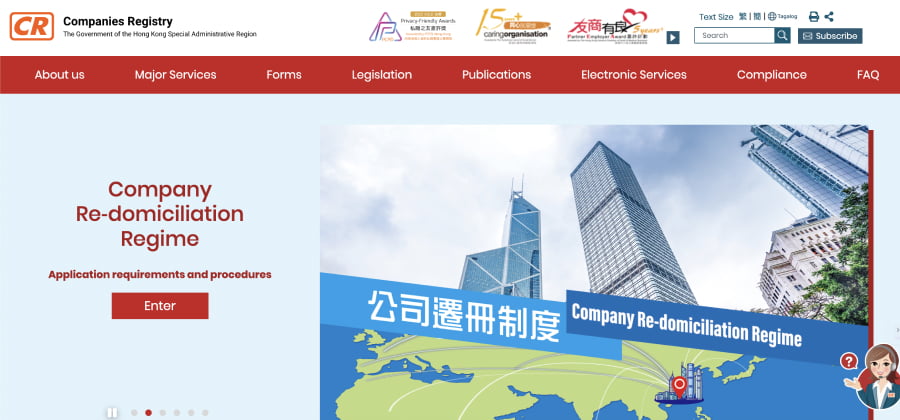
Hong Kong Companies Registry Website
What you receive at the end is not a stamped piece of paper but a digital certificate. The Certificate of Incorporation arrives as a PDF with a QR code, both a legal proof and a technological marker. At that moment, the company is real—listed in the public database, able to register with the Inland Revenue Department, able to open a corporate bank account, and able to trade. But one last license is still required: the Business Registration Certificate. Issued by the tax authority, it functions as the operational permit. Every company must have it, even those that are dormant, and it must be renewed yearly.
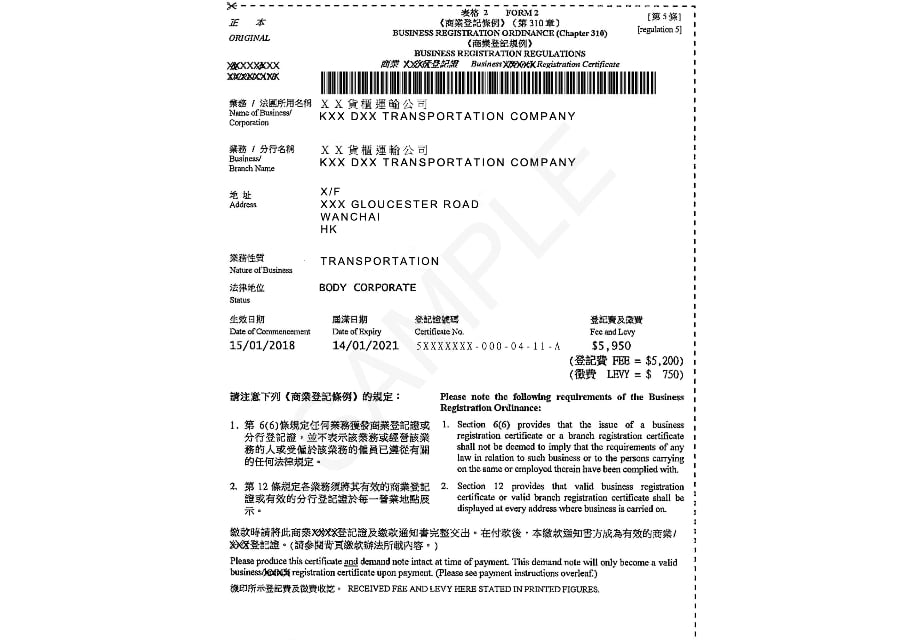
Sample Hong Kong Business Registration Certificate
For foreigners, what makes this entire process striking is not just the speed but the absence of artificial barriers. No law says you must be a Hong Kong resident. No one demands a local shareholder. Minimum capital is symbolic—one Hong Kong dollar. The language of government is English as much as Chinese. These small details add up to something rare: a major economy that treats outsiders almost exactly like insiders.
That combination—equal treatment, digital systems, and fast timelines—is why Hong Kong remains a magnet for international entrepreneurs. In a world where bureaucracy usually means delay, this city has managed to turn the act of incorporation into something else: a clear invitation to get moving.
The Fiscal Reality of Doing Business in Hong Kong
Anyone looking at Hong Kong as a place to incorporate quickly discovers a paradox. On one hand, the city is famous for its light touch, no-nonsense approach to business. On the other hand, it is definitely not a “wild west” where taxes don’t exist. In truth, Hong Kong strikes a careful balance: low rates, yes, but also crystal-clear rules and real consequences if you decide to ignore them.
So what does taxation look like for a company that decides to plant its flag here?
Profits, Not Turnover, Are Taxed
Forget about paying a levy on every sale. Hong Kong doesn’t bother with VAT or GST. Instead, it focuses narrowly on profit. If your company generates income inside the territory, that income becomes taxable, no matter where the parent company is based or what passports the owners hold.
And the rates? They’re split into two bands. The first HKD 2 million of profit (about EUR 234,000) is charged at 8.25%. Anything above that is taxed at 16.5%. This “two-tier” system is simple, predictable, and particularly kind to small and medium enterprises.
Duties Instead of Consumption Tax
Because there’s no VAT, many first-time investors assume Hong Kong is completely free of transaction taxes. Not so. Instead of taxing everyday sales, the government earns revenue from stamp duties. These apply in situations where large sums of money or long-term commitments are at stake: buying property, transferring company shares, or signing lease contracts. Depending on the value and nature of the deal, the rate can be anywhere between 0.2% and 4.25%.
In practice, this means consumer prices stay free of hidden tax lines, but investors moving real estate or corporate equity must budget for a significant extra charge.
What Else Can Appear on the Bill?
There are other costs that may apply depending on the business model: licenses for regulated activities, mandatory contributions to Hong Kong’s pension system (known as the MPF) if you employ local staff, occasional customs duties on goods imported from mainland China, and various filing or renewal fees charged by government offices. None of these are crushing, but they exist and need to be planned for.
Self-Assessment: You Do the Math
Perhaps the most interesting feature of Hong Kong’s tax regime is how it is administered. The government doesn’t calculate your bill for you. Instead, companies prepare their own accounts, figure out the profit subject to tax, and declare the result. This self-assessment model places responsibility squarely on the shoulders of directors. It is efficient, but it also means you can’t plead ignorance if you get it wrong.
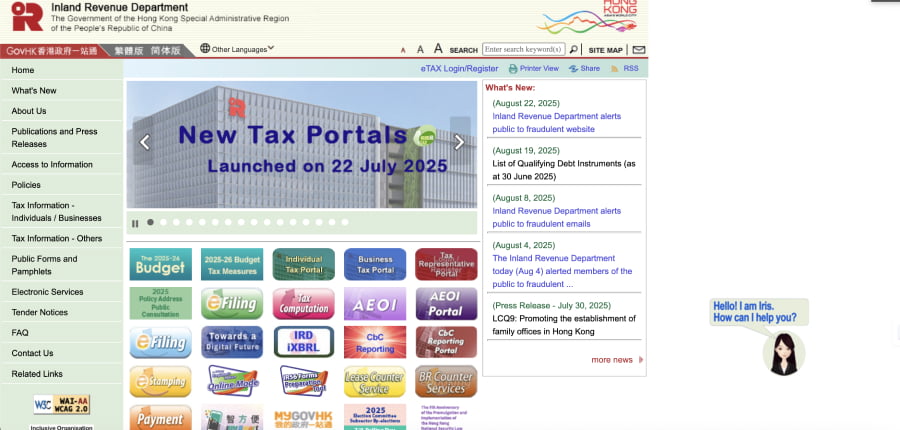
Inland Revenue Department (IRD) Website
Filing Is Obligatory, Even for Dormant Companies
Some founders think that if a Hong Kong company doesn’t trade, it doesn’t need to file. That’s a serious misconception. Every incorporated entity must submit returns each year, even if the numbers are all zero. The Inland Revenue Department expects to hear from you whether you are thriving, struggling, or completely inactive.
What Happens If You Don’t File
The punishments aren't just slaps on the wrist. If you miss a due date, you will be fined at least HKD 1,200. If you wait longer, daily interest will be added to the debts you don't pay. Keep ignoring your responsibilities, and the courts can strike off your business for good. Also, banks pay attention to people who don't follow the rules. It might be hard for a business that has missed files in the past to get new accounts in the future.
Compliance as a Strategic Choice
All of this adds up to a clear picture: Hong Kong rewards discipline. The rates are low compared to many Western economies, and profits earned outside the city are not taxed at all. But the authorities expect punctual reports, accurate numbers, and annual renewals of registration. The real mistake is to treat a Hong Kong company as if it were a paper shell that can be ignored after incorporation. Even a dormant firm has to keep up appearances—filing, renewing, and staying compliant.
For entrepreneurs willing to follow these rules, the city delivers exactly what it promises: a fair, efficient, internationally respected platform to build from. Hong Kong is not “offshore” in the old sense; it is something more valuable—a jurisdiction where opportunity exists, but only for those who treat compliance as part of doing business.
Opening a Corporate Bank Account in Hong Kong: Procedure and Requirements
After a company is officially formed, the next step is to set up the payment systems it needs to start doing business. At this point, a company goes beyond just papers and certificates and can start to accept payments, give out rewards, settle bills with suppliers, and get money from customers. To put it another way, having a company account in Hong Kong is not just a procedure; it is necessary for doing business.
At present, the jurisdiction is still open to international founders, but banks have tightened requirements dramatically. The change is a result of sanctions pressure, global scrutiny of cross-border flows, and stricter enforcement of anti-money laundering standards. Financial institutions are especially cautious when dealing with non-resident structures or with businesses in industries that attract enhanced regulatory attention.
Entrepreneurs have two primary avenues. They may approach a traditional Hong Kong bank, which suits large companies with a stable history, or they may opt for a licensed payment institution supervised by the Hong Kong Monetary Authority (HKMA). The latter category has become a preferred route for digital projects, e-commerce ventures, and fast-moving start-ups that value speed and flexibility.
What influences a bank’s decision?
Several factors shape how banks and payment providers assess each applicant:
- Beneficial owner status and jurisdiction. Preference is generally given to citizens of the EU, the UK, Singapore, and Hong Kong. Companies with owners from jurisdictions under sanctions—such as Russia, Iran, or North Korea—are subject to enhanced scrutiny.
- Geographic scope of operations. Banks react positively to firms that transact with highly regulated regions such as the EU, the US, or Japan. Dealings with offshore territories typically trigger requests for explanations and supporting evidence.
- Business model and source of capital. Institutions expect proof of real commercial activity. They evaluate the scale and logic of projected transactions, the rationale for choosing Hong Kong as a registration base, and the transparency of capital inflows.
Major institutions and their profiles
|
Institution |
Main characteristics |
|
HSBC |
Prefers large corporates and local structures; enhanced due diligence applied to most applications. |
|
Standard Chartered |
Works mainly with export-oriented companies. |
|
Bank of China (HK) |
Frequently requires directors to be physically present during application. |
|
Hang Seng Bank |
Shows greater openness toward SMEs and trading firms. |
|
DBS Bank (HK) |
Actively engages with digital enterprises and IT-focused clients. |
Each bank applies its own internal risk matrix. For example, HSBC often favors companies with an established operational footprint in Hong Kong, whereas Hang Seng is more inclined to onboard small trading businesses. For online commerce, alternative payment providers like Airwallex or Statrys may prove more efficient than traditional banks.
Documentation package
Applicants must prepare a complete dossier, usually including:
- Certificate of Incorporation.
- Founding documents: Articles and Memorandum of Association.
- Proof of identity and residential address for all directors and ultimate beneficial owners.
- Evidence of business activity (contracts, invoices, websites).
- Confirmation of tax registration (where applicable).
For higher-risk profiles—such as crypto, gambling, or fintech projects—preparation goes beyond collecting standard documents. Banks expect a full compliance pack, covering: capital flow mapping, designation of compliance officers, internal audits of the business model, and structured explanations of how regulatory requirements will be met. In many cases, institutions also schedule an online interview with the director, beneficial owner, and corporate secretary to verify information directly.
Practical realities
Even when the paperwork is formally correct, banks reserve the right to pause or reject applications if red flags appear. That’s why aligning all materials with FATF standards and HKMA guidelines is critical.
The review period varies: two to six weeks for traditional banks, and three to ten working days for payment systems. The cost of compliance checks and professional support ranges from EUR 800 to 3,000, depending on the complexity of ownership and the institution chosen.
Strategic advice
Before applying, it is strongly recommended to carry out an internal compliance audit. This exercise highlights weaknesses in the company’s structure, ensures the ownership chain is transparent, and prepares directors for potential questions. Addressing these issues in advance raises the chances of approval and shortens processing time.
Conclusion
Opening a company in Hong Kong may seem like a simple box to tick on the way to global expansion. After all, incorporation can be done remotely, the tax system is transparent, and the jurisdiction is known for its efficiency. But those who approach it as a quick administrative exercise risk disappointment. Hong Kong is not merely a registration center; it is a tightly regulated financial hub where compliance is the price of admission.
The pitfalls are familiar. Entrepreneurs often underestimate the importance of clean corporate documents or assume that a generic structure will be accepted without question. They may not realize that banks demand far more than incorporation papers—they want proof of actual activity, evidence of transparent ownership, and detailed compliance packs, especially in sensitive industries like fintech or digital assets. Even companies with sound models can face delays if directors or beneficial owners cannot demonstrate credibility during due diligence.
This is why preparation matters. Engaging professionals who understand both the letter and the spirit of Hong Kong’s regulatory framework transforms the process. A local advisor can review ownership chains, refine business models to withstand scrutiny, and ensure filings are not only accurate but strategically aligned with compliance expectations. Such preparation doesn’t just avoid rejection; it signals seriousness to banks and regulators, building trust from the start.
For investors, the takeaway is clear: Hong Kong is still one of Asia’s most open and advantageous jurisdictions, but opportunity comes with strings attached. To benefit fully, a company must not only exist on paper but also prove that it can operate responsibly in a global financial environment. Treat incorporation as a cornerstone, not a shortcut, and Hong Kong will reward that discipline with access, credibility, and long-term growth.
